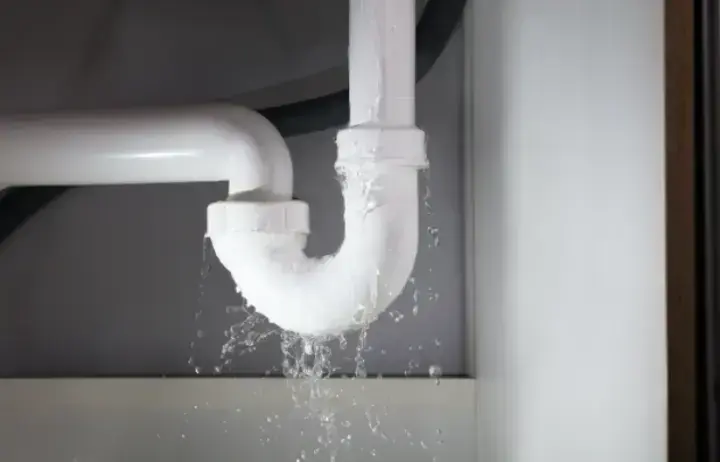
Menifee has grown quickly, and many of its newer homes sit in large tract neighborhoods built from the 2000s on. In those homes, the usual plumbing failure is not an old copper pipe but a fitting that lets go in a wall or attic.
Key takeaways
- Large tract neighborhoods such as Audie Murphy Ranch were built from the 2000s on, and PEX fitting failures are a known problem in newer tracts.
- Older Sun City homes tend to see copper pinholes, while newer homes see fitting failures.
- The main water valve should be closed first, and then the lowest faucet opened to relieve pressure.
- A burst pipe in a wall or attic needs extraction, a flood cut where needed and cavity drying.
- Insurance coverage depends on the policy and the cause, so photographs and notes matter.
Why newer tracts fail differently
Menifee includes Sun City ranch homes from the 1960s and 1970s, Menifee Lakes and Heritage Lake tracts from the late 1980s and 1990s, and large tract neighborhoods from the 2000s on. Each era tends to fail in its own way.
In older homes, copper can pinhole after decades of service. In newer tracts, PEX tubing is common, and the fittings that join it are the usual weak point.
Audie Murphy Ranch is one example of the large tract neighborhoods in Menifee. A plumber looking at a home there is more likely to find a fitting problem than a worn copper pipe.
- Sun City homes: Copper pinholes and slab leaks.
- Menifee Lakes and Heritage Lake homes: Wear on older pipes and fixtures.
- Newer tract homes: PEX fitting failures.
- Older lots in Quail Valley and Romoland: Their own mix of pipe and drain problems.
How a PEX fitting lets go
PEX is flexible tubing that connects to fittings with rings or clamps. If a ring is not set correctly or a fitting weakens, water can start spraying inside a wall or attic.
Because the pipe is hidden, the water can run for a long time. It soaks drywall, insulation and framing before anyone sees a stain.
A fitting that fails slowly can be as damaging as one that bursts. A drip that falls into insulation for weeks may only show after the ceiling below turns soft.
Signs of a hidden failure
A burst or leaking fitting often announces itself in a few ways.
- A sudden drop in water pressure.
- The sound of running water behind a wall.
- A wet spot or bubble in paint.
- A ceiling stain below an upstairs bathroom or an attic.
Why walls and attics suffer most
Water in a wall travels down the framing and into the floor. Water in an attic lands on insulation and ceiling drywall below.
What to do in the first day
A homeowner who finds a spray or a rapidly spreading stain should act quickly. The order below limits the damage.
Do not wait to see how bad it gets. A pipe that is spraying can empty a lot of water into a wall in a short period, so closing the main is always the right first move.
- Close the main water valve for the house.
- Open the lowest faucet to relieve pressure and drain the pipe.
- Turn off power to a room if water is near outlets or the ceiling is wet.
- Photograph the wet areas and the source if it is visible.
- Call a plumber for the repair and a team for burst pipe water damage cleanup.
How the wet wall and ceiling are handled
The team starts with extraction of any standing water. Water extraction is followed by moisture mapping with meters and a thermal camera.
A small flood cut opens the wall so the cavity can dry. Insulation that soaked up water is removed.
The team also checks adjacent cabinets, flooring and the room below. Water often travels farther than the visible wet spot, so the readings decide where equipment goes.
One wall or room
A leak confined to one wall or room usually needs a small flood cut, cavity drying and drying of the carpet in place. The site prints $1,800 to $4,000 for that case.
Upstairs leak to the floor below
When water reaches the floor below, the ceiling is opened and insulation removed. Two floors are dried, and the range runs $4,000 to $9,000.
Long run in several rooms
A fitting that ran for a long time can wet several cavities and hard flooring. That case runs $8,000 to $14,000 with extended drying.
Drying the structure to readings
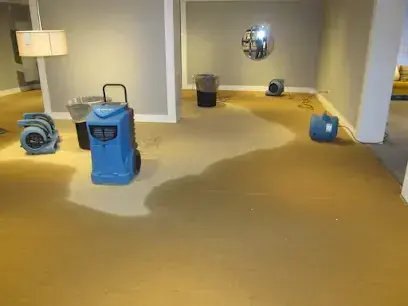
Drying does not end when surfaces feel dry. The team keeps air movers and dehumidifiers running until moisture readings match dry reference spots.
The structural drying step is documented with daily readings. That record is useful for the insurer and for the homeowner who wants proof that the wall is dry before it is closed.
Equipment placement is planned so air flows through the opened wall and across the floor. Fans and dehumidifiers are repositioned as readings change, so the drying stays efficient.
- Air movers push dry air through the cavity.
- Dehumidifiers pull moisture out of the air.
- Readings are taken each day and logged.
- The wall is closed only after readings reach the goal.
How long drying takes
A homeowner can use the drying time estimator to get a general sense of how long equipment may run. The actual time depends on the readings.
A wall cavity that was only briefly wet dries sooner than one that was soaked for days.
A simple note of the date the leak was found and the date the water was shut off helps. Those two dates tell the team and the insurer how long the wall was wet.
Insurance and the plumber
Coverage for a burst pipe depends on the policy and the cause. Sudden failure is usually treated differently from long term seepage.
A plumber repairs the fitting, and the restoration team handles the water. Keeping both invoices, along with photographs and notes, makes a claim easier to follow.
A homeowner can also ask the plumber to look at nearby fittings while the wall is open. Finding a second weak joint now is cheaper than another flood.
Questions
Why do PEX fittings fail in newer homes?
The joints between tubing and fittings are the weak point. A ring set incorrectly or a fitting that weakens can start a leak that stays hidden in a wall.
Do older Sun City homes have the same problem?
Older Sun City homes tend to see copper pinholes and slab leaks. Newer tract homes more often see fitting failures.
What should be shut off first?
The main water valve. Opening the lowest faucet afterward relieves pressure and drains the pipe.
Will the wall have to be opened?
Often a small flood cut is made so the cavity can dry. The team decides after taking moisture readings.
Is a burst pipe covered by insurance?
It depends on the policy and the cause. Sudden failure is often treated differently from long term wear.
Should nearby fittings be checked after one fails?
It is a good idea. When a wall is already open, a plumber can inspect nearby joints and fittings and replace any that look weak.