A brown stain spreading across a ceiling in late summer is often not a roof leak at all. In Wildomar, where the cooling season runs long, the more likely cause is the air conditioner above the ceiling.
Key takeaways
- Wildomar July and August average highs reach about 97.8 and 99.3 degrees F, so air conditioners run for months.
- A clogged condensate drain or a full pan in an attic air handler can drip into drywall for weeks.
- Shutting the system off stops the water, and a wet ceiling should be photographed before it is touched.
- The median home in Wildomar was built in 1992, so many air handlers are decades old.
- Wet insulation and drywall are removed and the ceiling dried to readings.
Why long cooling seasons cause ceiling leaks
Air conditioners pull moisture out of the air as they cool it. That moisture drains away through a small pipe, and in a long hot summer the system produces a great deal of it.
In Wildomar, July and August average highs reach about 97.8 and 99.3 degrees F. The cooling season is long, so the drain works hard for months.
A healthy drain keeps up with that load without anyone noticing. A drain that is partly blocked slows down, and the pan quietly collects water until it spills.
- Condensate: Water that forms on the cold coil while the system cools.
- Drain pipe: A small pipe that carries the water outside.
- Drain pan: A tray under the coil that catches drips.
- Float switch: A safety device that shuts the system off when the pan fills.
How an attic air handler leaks into a ceiling
When the drain clogs, the pan fills and then overflows. In an attic, the overflow lands on insulation and then on the ceiling drywall below.
The water soaks in slowly. The first sign is often a faint tan or brown stain that grows each time the system runs.
A homeowner usually sees the stain before anything else. By then, the insulation above the stain may already be wet, so the damage is larger than the mark suggests.
Common causes
Most condensate leaks come from a short list of problems. Each is simple, but each can cause a lot of damage if it runs unnoticed.
- A drain pipe clogged with algae or sludge.
- A rusted or cracked drain pan.
- A drain pipe that has shifted or lost its slope.
- A float switch that fails to shut the system off.
Why it is slow and hidden
The leak happens only when the system runs, so it can start and stop over weeks. Insulation hides the water, and the drywall may not stain until it is saturated.
What a Wildomar homeowner should do right away
The first step is to stop the water. The second is to record what happened.
A few steps protect the house while the cause is found.
A flashlight and a phone camera are enough to document the stain. Photographs taken over several days show whether it is growing, which helps the technician judge how long the leak has been running.
- Turn the air conditioner off at the thermostat and the breaker.
- Place a bucket under any dripping spot and move belongings away.
- Photograph the stain and mark its edge with a pencil so growth can be seen.
- Do not poke or cut the ceiling unless it is sagging and water is pooling.
- Call an HVAC technician for the drain and a team for AC condensate leak cleanup.
How the ceiling is checked and dried
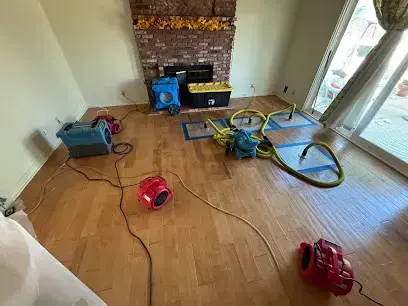
The restoration team starts with moisture meters and a thermal camera. These show how far the water spread above and below the stain.
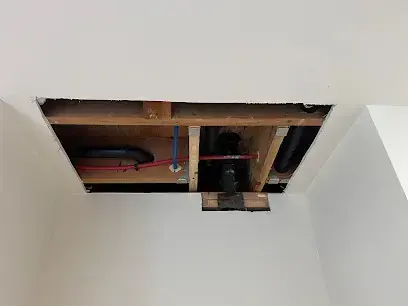
Wet insulation is removed from the attic, and the drywall is opened if it is saturated. The goal is to dry the ceiling and the joist bays, not just cover the stain.
The room below the stain is checked as well. Water that drips from a ceiling can reach the carpet, a nightstand or a wall base, and each of those has to be dried.
A homeowner can find more about the area on the Wildomar water damage restoration page.
Small stain
A small stain caught early can often be dried in place. The site prints $900 to $2,200 as a typical range for that case.
Opened ceiling
When the drywall is soft or sagging, it is cut out and wet insulation removed. Ceiling leak water damage work then dries the room below as well.
That range runs $2,200 to $6,000.
Overflow that ran for days
When the drain overflowed for several days, walls and flooring may be wet too. That case runs $5,500 to $10,000 on the site.
Older systems in newer looking homes
The median home in Wildomar was built in 1992. Many air handlers in homes of that age have been in service for years and may have older drain pans and drain pipes.
Wildomar has 11,251 housing units, and 78.3 percent of occupied homes are owner occupied. A homeowner who has not had the system serviced in a few years can ask a technician to check the drain.
Newer systems also fail. A drain pipe that was glued or sloped poorly at installation can clog at any age, so a newer home is not immune.
- Flush the drain pipe as part of regular service.
- Check that the float switch works.
- Look at the drain pan for rust or cracks.
- Keep records of service visits.
The dry months do not finish the job
Rain in Wildomar falls mainly from November through April. That does not mean the dry months are safe, because a condensate leak does not depend on rain.
Water in a ceiling or attic needs equipment drying no matter the season. Dry air outside does not pull water from inside drywall and framing.
A rainy winter and a dry summer follow the same rule inside a ceiling: water stays until equipment removes it. That is why the drying plan follows readings and not the weather.
Insurance and repairs
Coverage for an AC drain leak depends on the policy and the cause. Sudden damage is often treated differently from long term seepage, so the policy should be read before the claim is filed.
Photographs, service records and receipts all support the claim. The HVAC repair and the restoration work are usually billed separately.
A service record also helps. A drain that was flushed during a recent check is a different case from one that was never cleaned, and the insurer may ask which it was.
The same process applies across the area, and the main AC condensate leak water damage page shows the full steps and typical ranges.
Questions
How can a homeowner tell an AC leak from a roof leak?
A stain that grows when the air conditioner runs, with no rain, points to the system. A roof leak tends to follow rain.
Is it safe to keep running the air conditioner?
Not while the drain is leaking. Turning it off stops the water until a technician fixes the drain.
What does a typical cleanup cost?
The site prints $900 to $2,200 for a small stain, $2,200 to $6,000 for an opened ceiling and $5,500 to $10,000 for an overflow that ran for days.
Can a ceiling stain be painted over?
Painting over a wet ceiling hides the problem without drying it. The ceiling should be checked with a moisture meter first.
Why does the stain appear in summer?
The air conditioner makes the most condensate in the hottest weather, so a clogged drain overflows then.
Who fixes the drain and who dries the ceiling?
An HVAC technician clears or repairs the drain and the pan. The restoration team dries the ceiling, removes wet insulation and documents the readings.